
Old Media Takes It On The Chin From Scott Adams – Inadvertently.

Scott Adams wanted to make a topical comic about the recent iPhone 4G drama that’s been all the buzz recently and realized that his normal outlet (a newspaper) has a propagation delay of about a month.

“I worried that the story would become stale before my comics would work through the pipeline.”

His only option in order to be topical and current was to post his comic online.

“I think the soonest I can get something published is in about a month, perhaps a bit sooner…”

Wow.  I don’t believe Scott meant to take a swipe at newspapers per se, but his comment shows just how little has changed in that business despite their use of computers for composition and wire feeds via data circuits.

Granted, Scott is not (nor am I) an investigative journalist, but when Scott, I and others can create content, publish it, be indexed by a search engine and be seen by millions (Scott, not me) in a matter of minutes – the value of traditional outlets for media, news and commentary plummets quickly.  Since this is nothing new, the real story here is that after years of TV and newspapers being pummeled by the new and recent content outlets on the Internet they still can not refine the process for something as simple as publishing a comic.

If Matt Stone and Trey Parker can accomplish the seemingly Herculean feat of being topical in their weekly animated South Park episodes, why can’t a newspaper do the same for a three-panel comic?

I believe this underscores the challenges and difficulties that entrenched media outlets face.  They have very old and set ways of performing a function with very narrow and short-term views interested only in placing controls and locks on the dwindling amount of content they still create.

Moreover, in order to keep up with rapidly changing times the internal resistance is too great to overcome and inevitably the changes that are made are incremental and often lagging behind the younger companies that “get it”.

Get it?

A Good Engineer Is Hard To Find… For TV Anyway.

I was recently talking with a sales rep I deal with and we got on the topic of the aging TV engineering workforce.  He told me a rather depressing story about a recent SBE chapter meeting in his area where one of the old timers started poking fun at a couple  younger members who were working on their Mac laptops and had iPhones – apparently he felt that broadcast engineering was PC only which just shows how out of touch this guy is.  The upshot here is that these were interested young technical professionals who just came to a broadcast engineering meeting to learn something new only to be berated by someone who probably won’t be in the business very much longer.  What incentive do these young men have for returning to the next meeting when one of the people that should be passing the torch is instead using it to burn bridges?

Recently, a broadcast publication, TV Technology, published an overdue article lamenting the fact that well trained, or at least interested, young technical talent is hard to find and even harder to retain in the broadcast engineering field.  If you need proof, just stop by the annual Society of Broadcast Engineers member’s meeting that goes on every year during NAB – you’ll walk in and see a lot of gray and balding heads (mine will be in there too).

In the article James Careless goes on to list several key elements that could be used to lure attract entice interest fresh faces to the field of broadcast engineering:

  • Emphasize the IT side of the broadcast plant.
  • “Jazz Up” the image of broadcast engineering.
  • A new IEEE course being developed called “Bridging the Broadcast/IT Gap” to bring older engineers in touch with newer technologies that could work in reverse for IT-minded youngsters.
  • and “it couldn’t hurt to boost the pay”.

I think the last item is where James buries the lead.  The last item on the list really should be the first item on the list.  Boosting pay is the only way to attract young geeks (like me) into the non-standard workday/workweek and workplace that is broadcast television. Continue reading “A Good Engineer Is Hard To Find… For TV Anyway.”

Terrestrial Radio. It’s as bad as I remember.

It’s been about five years since I bought into Sirius satellite (paid) radio.  At the time, like many initial customers,  I was spending a lot of time in a company truck.  For me it was driving from hilltop-to-hilltop working on transmitters or to various studios within “driving distance” and I quickly became fed up with driving out of range of a station’s coverage during an interesting talk-radio discussion or good song coupled with the dearth of variety, but the bounty of repetition.

The initial realization when initially using satellite radio is the sheer amount of content variety which are instantly available.  Not only are various musical formats lined up to cover any taste, there are major sporting events (even football games) broadcast live.  One of my all-time favorites (since I’m not easily offended) is the Raw Dog Comedy channel.  A channel so replete with the “seven words you can never say on television” (or radio) I believe it has to be their most popular channel – although I cannot find any readily available ratings or stats to prove my assumption.

George Carlin explains the “seven words”.

Even though Howard Stern is their flagship personality with an uninhibited vocabulary and format I just don’t find him nearly as funny as the comics on Raw Dog.  And when I tire of grinning broadly and laughing like a manic hurtling down the freeway I can always find a musical mix or talk radio show to fill the empty ride.

Continue reading “Terrestrial Radio. It’s as bad as I remember.”

Cable’s Latest Attempt to Elminate Local Channel Carriage

A new article in Broadcasting & Cable highlights the American Cable Association’s attempt to sway the FCC via a December 11th letter by the ACA President Matt Polka (in addition to the regular lobbying of cable-related issues through their PAC) to eliminate “Must Carry” rules so that they can “offer Internet speeds as fast as 100 Mbps with minimal upgrades to their existing plants through a process called channel bonding.“

This is nothing short of a “land grab” for Big Cable to kick the broadcasting industry while it’s viewership and revenue is down and use the promise of amazing Internet access speeds (for the extreme minority of subscribers that could afford and/or would like to have it) to free themselves of having to pay local broadcasters for carriage of their content.

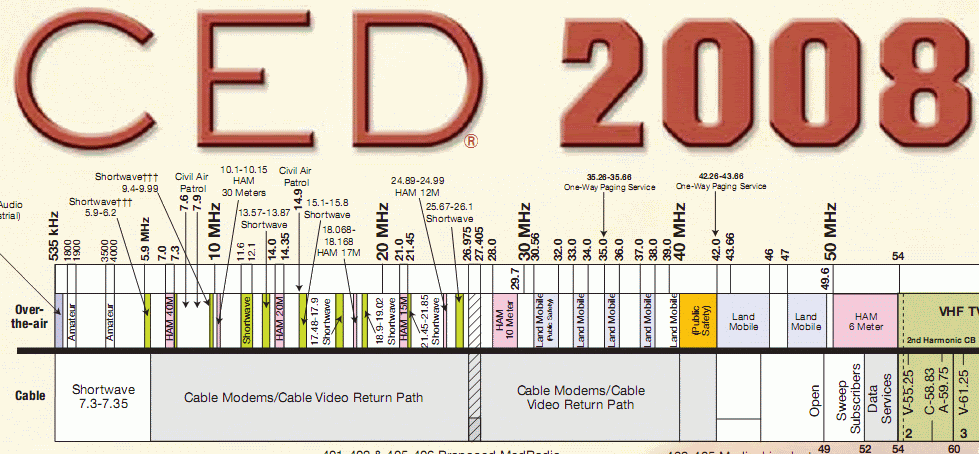
Using the CED Magazine Freq Chart as a guide (excerpt below) one can see that current cable modems, which provide the highest Internet access speeds for the average public short of FiOS service from Verizon, only occupy the space between 6MHz and 40MHz (34MHz total) out of the typical 1GHz available to modern CATV deployments.  In other words, about 3.4% of their total capacity.  Adding the space of another 4 TV channels (24MHz) increases the total cable modem bandwidth usage 58MHz (5.8% of total capacity).

Portion of the CED Freq Chart


Continue reading “Cable’s Latest Attempt to Elminate Local Channel Carriage”

The DTV Delay Debacle. Just cut the cord already…

Recently our congress has passed legislation to delay the DTV transition/analog shut-off yet again – this time to June 12th of 2009.  For those that aren’t already aware this makes the 2nd time the date has been put off.  The original date (created in 1997) for this to happen was December 31st, 2006, but in February of 2006 legislation was created to change the date to February 17th, 2009.

One interesting element with this administration is the online posting of the bill (as of this posting it hasn’t been signed into law) on the White House website and the ability to add public comment.  Just because I could, I added my own two cents which is likely to be promptly ignored:

I believe the delay, while appearing to be in the public’s best interest, actually will cost local TV stations more money to keep obsolete , power-hungry transmitter facilities running that will in turn, drain station budgets when they were un-prepared to absorb the expense.  This is exacerbated by the fact that it is a non-political ad year AND the amazingly bad economy.  The net result is that projects will go unfunded and station workers laid-off to mitigate the added operational expense.

They wisely limited me to 500 characters.  Meanwhile, I’ve found that my views are not just echoed by fellow broadcast engineers, but by an FCC commissioner as well. Continue reading “The DTV Delay Debacle. Just cut the cord already…”

Hello Mobile DTV. Goodbye HDTV.

Regardless of what some liberal arts students or free-love hippies may tell you, you don’t get something for nothing.  Or, better yet, as the redoubtable Robert Heinlein coined, “TANSTAAFL” (There ain’t no such thing as a free lunch).  This simple truth frames the cold, hard realities about to face broadcasters after the current mobile DTV trials wrap up.  It will weigh even heavier when the mobile standard is finalized and equipment is available for purchase in Q2 (tentatively) of 2009.

An ad by Anaren that appeared in Microwave Journal.

When cable companies take a broadcaster’s primary digital signal, either from an over-the-air broadcast or a direct fiber feed, they tend to re-sample it (unless they under an agreement expressly forbidding it), put it on one of their available 38.8Mb capacity QAM channels and share that QAM channel with another digital channel (or two or more!) shaving the channel’s data rate in the process.  Some cable companies are more aggressive than others in their re-compressing.

Continue reading “Hello Mobile DTV. Goodbye HDTV.”

Dr. Horrible Tops In ‘TV Shows’ On iTunes. Only It’s Not A TV Show…

As broadcasters continue to face eroding audiences, lousy programming, declining ratings, a lackluster fall line-up and pending changes in FCC rules regarding ‘localism‘; here comes another punch in the gut.

Joss Whedon of Buffy The Vampire Slayer, Firefly and the Serenity movie fame created a three part mini-musical (!) video netcast called “Dr. Horrible” that only lasted a few days and was born from the catalyst of the recent writer’s strike.

Once upon a time, all the writers in the forest got very mad with the Forest Kings and declared a work-stoppage.

The Doctor Horrible Site

Only one day after the three acts were pulled from the site (as per Joss’ schedule) the mini-netcast series wound up taking the top three slots in the TV Shows Download section on iTunes. Continue reading “Dr. Horrible Tops In ‘TV Shows’ On iTunes. Only It’s Not A TV Show…”

Local Broadcasters Can’t Catch A Break. Mostly Their Fault.

A writer’s strike, shitty programming and the Internet. Oh my!

Viewer’s are leaving appointment television by the droves and broadcasters are scrambling to do something, anything to keep them firmly planted on the couch during prime time. I’ve covered the topic of declining viewers in the past, but the trend in hemorrhaging viewership of major network programming and in turn local broadcast stations is accelerating, even as the number of overall television viewers are up and as many cable shows enjoyed their best ratings during the month of April. The “Big Four” networks lost 9% of their viewers over the 2008 April/May period from 2007 and last year they were already down 5% from 2006.

Image courtesy Los Angeles Independent Media Center

During the writer’s strike from November 5, 2007 to February 12, 2008 broadcast networks complained in advance that their ratings would suffer, but that it was a temporary setback in their business. Well, enough time has passed for the numbers to come out and set a table for them to eat their words. A good summary of the broadcast losers and cable winners over the past few months can be found here. Continue reading “Local Broadcasters Can’t Catch A Break. Mostly Their Fault.”

Competition for Cable & Satellite? Says Who? Sezmi.

Sezmi is a startup out of Belmont, California that hopes to win subscribers from cable and satellite providers by providing a cheaper, on-demand and real-time television viewing service for a select selection of the more popular broadcast and “cable” channels.

The evolution of Sezmi.

This new company is born from the ashes and founders of the defunct USDTV service that burned through its cash from investors such as Fox Television Stations, Hearst-Argyle and LIN TV, but ultimately ceased operations back in March 2007.  Previously under the stealth name “Building-B“, Sezmi recently unveiled their new commercial name and are again trying to entice the interest of broadcasters into donating part of their digital television data stream in order to help make their business model work. Continue reading “Competition for Cable & Satellite? Says Who? Sezmi.”

Breaking the chains. Dumping my cell phone contract.

First, let me say that this will not work for everyone and those teenagers that have their parents footing the mobile bill, unfortunately, will not feel the financial pain of owning a cell phone. At least, not yet. However, many people are in the same boat as myself carrying a work cell and a personal cell since I bought one on my own along with a second for my wife. The phone I was issued is a very capable Blackberry 8830 with a link to the company Exchange server for e-mails and an unlimited data plan (Google Maps is so damn handy!), so I don’t use my personal phone all that much. I do conduct personal business with contacts I keep separate from work and a personal cell is perfect for that.

Therefore, while I was going over my monthly budget spreadsheet about a while back I took a cold, hard look at just how much we actually use our phones and if this 700-minute-per-month plan with Verizon for my Treo 700p and the wife’s RAZR was really worth it. In a nutshell, no. Continue reading “Breaking the chains. Dumping my cell phone contract.”