

At about 4 am we lost power on V1 and remotely found the cabinet would not become ‘ready’. On-site it was quickly apparent that tube bias was not satisfied and looking over the schematics again I decided to quickly isolate the tube to know where I should start looking. As soon as I pulled the bias voltage lead from the tube HV junction box the bias supply came back up to normal (https://youtu.be/iqqVXn7s8aA), so my first thought was that we lost the tube to a cathode-grid short.
Continue reading “More Transmitter Caps Gone Bad”A New Transmitter Problem – ‘Paper Cap’ Short!
Quite suddenly and without warning on February 27th, the V2 cabinet for our KBCW was constantly crowbarring (a safety function on high-voltage/high-power transmitters to prevent a tube short or other high beam current events from destroying the Inductive Output Tube) and would not hold high voltage for any amount of time putting our transmitter at half power – our other amplifier cabinet was working normally. As soon as we went to ‘beam on’ and high voltage was applied the crowbar circuit would trip and the only fault would be a very generic and mostly unhelpful ‘crowbar fault’ – nothing else.
Continue reading “A New Transmitter Problem – ‘Paper Cap’ Short!”
iPad Mobile DTV FAIL [Pic]
While checking the Mobile DTV pavilion at the NAB convention in Las Vegas today I came across several mobile and portable devices showing off how well they can decode and display the new mobile DTV signals being broadcast. All save one…

A Good Engineer Is Hard To Find… For TV Anyway.
I was recently talking with a sales rep I deal with and we got on the topic of the aging TV engineering workforce. He told me a rather depressing story about a recent SBE chapter meeting in his area where one of the old timers started poking fun at a couple younger members who were working on their Mac laptops and had iPhones – apparently he felt that broadcast engineering was PC only which just shows how out of touch this guy is. The upshot here is that these were interested young technical professionals who just came to a broadcast engineering meeting to learn something new only to be berated by someone who probably won’t be in the business very much longer. What incentive do these young men have for returning to the next meeting when one of the people that should be passing the torch is instead using it to burn bridges?

Recently, a broadcast publication, TV Technology, published an overdue article lamenting the fact that well trained, or at least interested, young technical talent is hard to find and even harder to retain in the broadcast engineering field. If you need proof, just stop by the annual Society of Broadcast Engineers member’s meeting that goes on every year during NAB – you’ll walk in and see a lot of gray and balding heads (mine will be in there too).
In the article James Careless goes on to list several key elements that could be used to lure attract entice interest fresh faces to the field of broadcast engineering:
- Emphasize the IT side of the broadcast plant.
- “Jazz Up” the image of broadcast engineering.
- A new IEEE course being developed called “Bridging the Broadcast/IT Gap” to bring older engineers in touch with newer technologies that could work in reverse for IT-minded youngsters.
- and “it couldn’t hurt to boost the pay”.
I think the last item is where James buries the lead. The last item on the list really should be the first item on the list. Boosting pay is the only way to attract young geeks (like me) into the non-standard workday/workweek and workplace that is broadcast television. Continue reading “A Good Engineer Is Hard To Find… For TV Anyway.”
Hello Mobile DTV. Goodbye HDTV.
Regardless of what some liberal arts students or free-love hippies may tell you, you don’t get something for nothing. Or, better yet, as the redoubtable Robert Heinlein coined, “TANSTAAFL” (There ain’t no such thing as a free lunch). This simple truth frames the cold, hard realities about to face broadcasters after the current mobile DTV trials wrap up. It will weigh even heavier when the mobile standard is finalized and equipment is available for purchase in Q2 (tentatively) of 2009.
When cable companies take a broadcaster’s primary digital signal, either from an over-the-air broadcast or a direct fiber feed, they tend to re-sample it (unless they under an agreement expressly forbidding it), put it on one of their available 38.8Mb capacity QAM channels and share that QAM channel with another digital channel (or two or more!) shaving the channel’s data rate in the process. Some cable companies are more aggressive than others in their re-compressing.
Another DTV Converter box goes under my microscope. OK, my glasses…
Not too long ago I had some time to review the capabilities of an Insignia CECB (coupon eligible converter box) and found that it was quite capable for its intended purpose. However, it lacked a few features and I discovered a matrix that showed one converter box with the most features of any CECB and it was for sale at a local Best Buy.
The Apex DT250 sold for $60 like the other CECBs and is a similar size and form factor. If you have $40 coupon this box would only cost $20 plus tax. The difference it has from many of the other converter boxes is that it provides for analog pass-through and the ability to control a smart antenna. Since I do not have a smart antenna on hand (right now no one does) I focused on its ease of use and performance in picking up OTA digital signals.

Continue reading “Another DTV Converter box goes under my microscope. OK, my glasses…”
NAB 2008 In Review.
This year’s NAB had a bit more energy among television broadcasters than the NAB show last year and almost all of it was around the mobile DTV plans and testing currently going on. Despite the interest in mobile DTV and the NAB claiming ~105,000 registered attendees, the North and Central halls were only mildly busy. Attendance, as judged by “elbow room” has significantly waned year after year and it is easier to navigate the halls and major vendor booths. Broadcasting & Cable agrees with me on this.

The South upper and lower halls of the Las Vegas Convention Center, by way of contrast, were significantly more energetic, crowded and younger! Since the South halls were occupied by film production/support companies and smaller “new media” (read: Internet related or centric) businesses this comes as little surprise to me. Two notable companies that abstained from attending NAB this year were Avid and Apple. Apple really didn’t have a need to attend this trade show, but Avid’s considerable customer base for their product, outside of film, is the broadcast community and their absence does not portent good business sense or, more importantly, sales for the future and their stock price seems to reflect that.

During the show I did notice more DTV transmitters on the floor than last year. Continue reading “NAB 2008 In Review.”
DTV “coupon” converter box put to the test. Does it work?
No “film at 11” drama here; yes, it works and it works surprisingly well for a $60 piece of electronics ($20 after the $40 coupon is applied).
For those that don’t know, this Insignia brand NS-DXA1 DTV converter box is one of a few available devices which are part of the US government’s effort to make it possible for people to view over-the-air DTV broadcasts on older, analog-only televisions when the analog transmitters (about 1,700 of them nationwide) are required to cease operations on February 17th, 2009. The coupon program’s plan is to provide a way for those on fixed incomes, or the inability to replace their existing set with one that has a digital OTA tuner in it, to continue to view their favorite local broadcast stations. Continue reading “DTV “coupon” converter box put to the test. Does it work?”
How the format war has changed my purchasing habits.
To be succinct, I simply don’t (and won’t) buy as much as I did before. For the past few years I didn’t think too hard about buying the week’s more popular DVD release of the latest blockbuster (or near blockbuster). This is why my DVD collection sprang to over 400 titles! I didn’t always buy full retail on “new release Tuesday” if I found bargains of popular movies that had been on DVD for a few months already and retailers were anxious to thin their inventory, but the collection grew and represents quite a sizable chunk of change. Continue reading “How the format war has changed my purchasing habits.”
Visiting an SF Landmark. Sutro Tower.
Not many people get inside Sutro Tower, so I consider myself pretty fortunate. My current employer doesn’t have transmit facilities or other interests at Sutro, so I was escorted through the gate and into the facility by a contract engineer, John Buckham, that our SF station has who also maintains a radio station there for another employer of his.
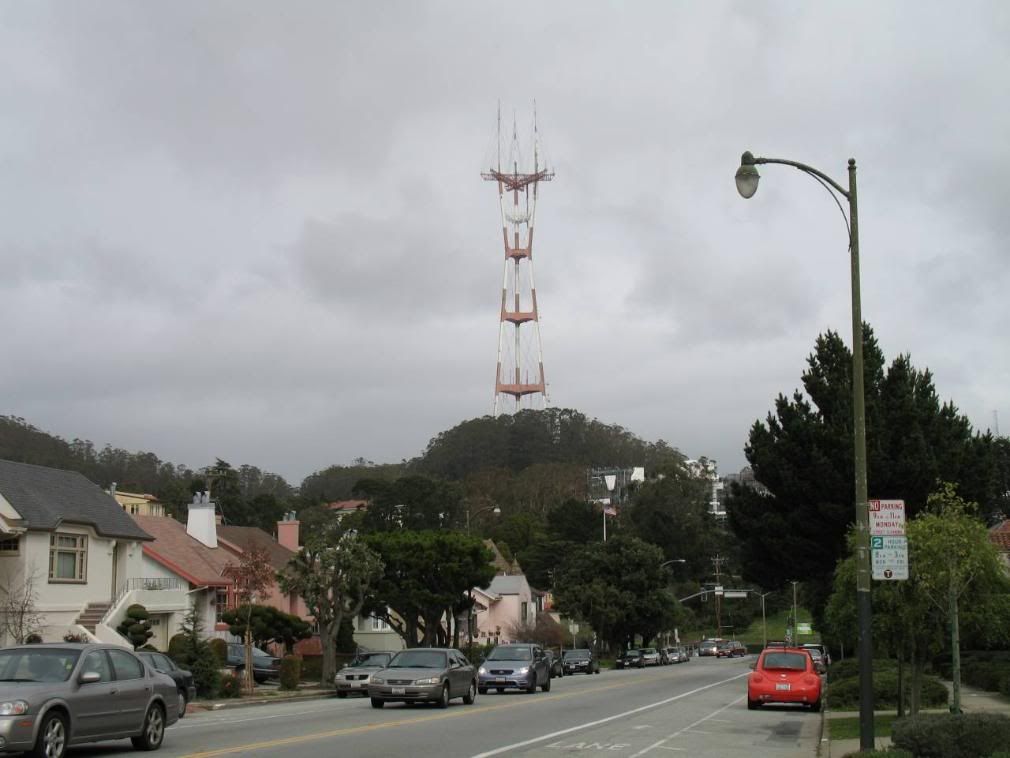
This was a unique opportunity for a few reasons; since I don’t work there, getting access is impossible unless you know someone and can get something arranged. This is a historically interesting site and it is a unique tower engineering design that has currently weathered 25 years of use. Continue reading “Visiting an SF Landmark. Sutro Tower.”